
The term “radioactive labeling” can refer to a wide variety of different methods. It ranges from the labeling of proteins to cells and even entire organisms for the purposes of biological and biochemical research.
In addition, the field of tracer development for nuclear imaging also falls under this category.
In addition to labeling conducted by other research groups in our lab, we focus in particular on the labeling of microalgae. These serve as a type of tracer to transport radionuclides for imaging in relevant organisms.
For example, we were able to successfully label the species Chlorella sorokiniana with 18F-FDG and then use it as a tracer for PET imaging of blue mussels (Mytilus edulis).
Another project involves the labeling of marine dinoflagellates, which live symbiotically in sea anemones and corals. The goal of this project was to perform PET imaging of corals to investigate their metabolic processes and the effects of environmental factors on them.
Analyse zellulärer Prozesse durch radioaktives Labeling
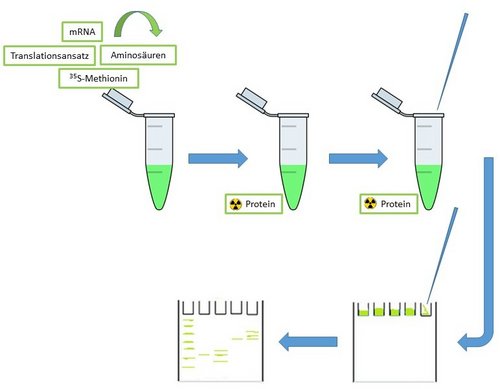
Proteins can be detected within the cellular system using many methods, and their transport pathways can be tracked. These include, for example, fluorescent labeling, detection using antibodies, or isolation using tags. However, these methods have the disadvantage that the proteins must be modified, which alters their size or other properties. Radioactive labeling, on the other hand, works by replacing individual elements with their radioactive isotopes—for example, the sulfur in the amino acid methionine with the isotope sulfur-35. The labeled protein thus behaves identically to the unmodified protein and can also be detected in very small quantities.
The simultaneous use of a cell-free in vitro system enables the analysis of cellular processes, including translation and transport into the ER, on a very small scale (~10 µl). In addition, various post-translational protein modifications can be detected. Subsequently, it is possible to analyze protein interactions through radioactive cross-linking. In collaboration with the Institute of Biology, various aspects of ER import of proteins in mammalian membranes are currently being investigated.
Contact: Alexandra Schatt